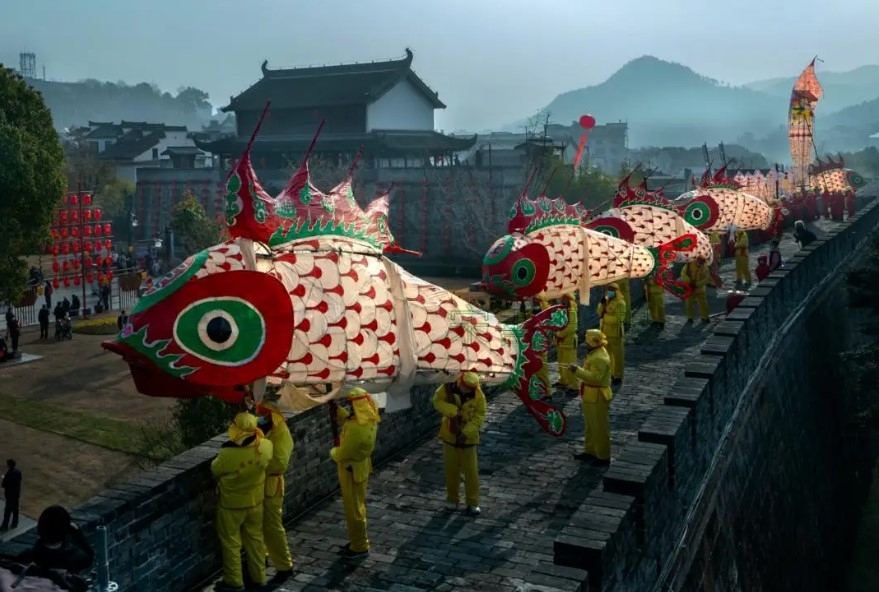
Wangmantian Village, Xitou Town, Shexian County, Huangshan, Anhui — September 25. Gongs and drums thundered through the ancient lanes of Wangmantian Village on the evening of September 25, as dozens of enormous fish lanterns weaved along the village’s bluestone paths, their swaying heads and shimmering tails resembling a flowing river of stars under the night sky. Held during China’s Farmers’ Harvest Festival, the centuries-old “fish lantern parade” in this Song-dynasty village offered prayers for bumper harvests and abundance year after year.
The Wangmantian fish lantern tradition, with a history of over 600 years, was created by villagers to honor their ancestors and pray for peace, and is listed as Anhui provincial intangible cultural heritage. The lanterns feature bamboo-strip frames covered with rice paper and painted scales; the largest measures over four meters long and requires four bearers. As the procession winds through the lanes, households set off firecrackers to welcome the passing lanterns, symbolizing “the carp leaping over the dragon gate and the family thriving.”
“I started learning lantern-making from my father at fifteen. This craft has been passed down to me through five generations,” said 59-year-old Wang Zhengqiu, an inheritor of the craft, as he fitted candles into a lantern. “This year, all the young people came back to help for the Harvest Festival. We made more than sixty lanterns—the largest display in a decade.”
Alongside the parade, the village hosted a harvest-photo exhibition, a traditional Huizhou ciba (pounded glutinous rice cake) making workshop, and displays of traditional farm tools. Strings of golden chili peppers and fiery persimmons blanketed the drying racks of Huizhou-style houses, drawing crowds of photography enthusiasts. According to local culture and tourism authorities, Shexian County received over 120,000 visitors during the festival, generating nearly 90 million yuan in tourism revenue.
“Folk customs are the roots and soul of a village,” said the head of the county’s culture, tourism and sports bureau, noting that the county is building a “one village, one brand” cultural tourism matrix centered on intangible heritage, transforming ancient traditions into a new engine for rural revitalization.